Donald Insall was a pioneering conservationist, architect, planning consultant, author and teacher, he founded Donald Insall Associates in 1958, one of Britain’s leading conservation practices.
Insall was keen to stress the difference between preservation and conservation. Preservation he said is “what you do for marmalade”. In the case of buildings, this means keeping them in their original state for posterity. Conservation means working with old buildings, streets and towns in ways that allow them to live on usefully and delightfully for new uses when and where appropriate and for future generations. Insall summarised his philosophy, principles and practice in Living Buildings (2008; reprinted with a foreword by the Prince of Wales in 2018), a comprehensive testament to all that’s best in the work of conservation architects.
From the renovation of the early 18th Century Baroque Wotton House, Buckinghamshire, saved from demolition in 1957 at the very last moment to the sensitive renovation of William Morris’s Kelmscott Manor, Oxfordshire, Robert Adam’s Kedleston Hall, Derbyshire, the conservation of Chester’s historic centre and the restoration of Windsor Castle following the devastating fire of 1992, Insall led teams of skilled architects, craftsmen and builders to subtle and extraordinary extent.
Donald Insall was born in Bristol in February 1926 to a family of long established and successful leather, trunk and portmanteau manufacturers. He attended Bristol Grammar School observing studiously as his father commissioned and built a new family home at Henleaze in the north of the city. Having witnessed the destruction of Bristol’s ancient churches and historic buildings during the Blitz, he began his architectural studies in 1942 at the Royal West of England Academy School of Architecture. He completed these after being demobbed in 1948 following service with the Coldstream Guards.
Insall moved to London to study civic design at the Royal Academy Schools and later at the School of Planning. A Lethaby Scholar with SPAB (the Society for the Protection of Ancient Buildings, founded by William Morris in 1877), he worked with traditional craftsmen including thatchers and lime plasterers before spending eighteen months measuring Winchester College for the medieval historian John Harvey.
He got to know and understand historic buildings of all periods. “I love them all”, he said. “When society is changing, the buildings that society puts up will be changing; it’s all parts of a lively continuity.” What mattered most, though, is the quality and the care not just of individual buildings but also of their relationship to the streets, towns and cities of which they were a part. The work of conservation architects was, Insall believed, to help make “every place to be truly more itself.”
He joined Phillimore and Jenkins, a London practice specialising in the design and restoration of country houses, together with fellow Lethaby Scholar Peter Locke with whom Donald founded Donald Insall Associates in 1958 working from the kitchen table of Insall’s small flat off Belgrave Square.
Insall was a driving force in the workings of the Ancient Monuments Board and the Historic Buildings Council for England where he befriended, among others, the architectural historian John Summerson and historians and conservation activists Nikolaus Pevsner and John Betjeman. These bodies led to the creation of English Heritage in 1984. Donald Insall was a founding commissioner.
Before this, Insall’s study of Chester, published in 1968, proved to be an international landmark for urban conservation. Donald Insall Associates visited more than four hundred buildings and in doing so showed that what is best from the past should be conserved for positive change to the city. This led to Insall’s appointment - a first - as Conservation Consultant for the City of Chester and, ultimately, to the creation of conservation officers by local councils across the country.
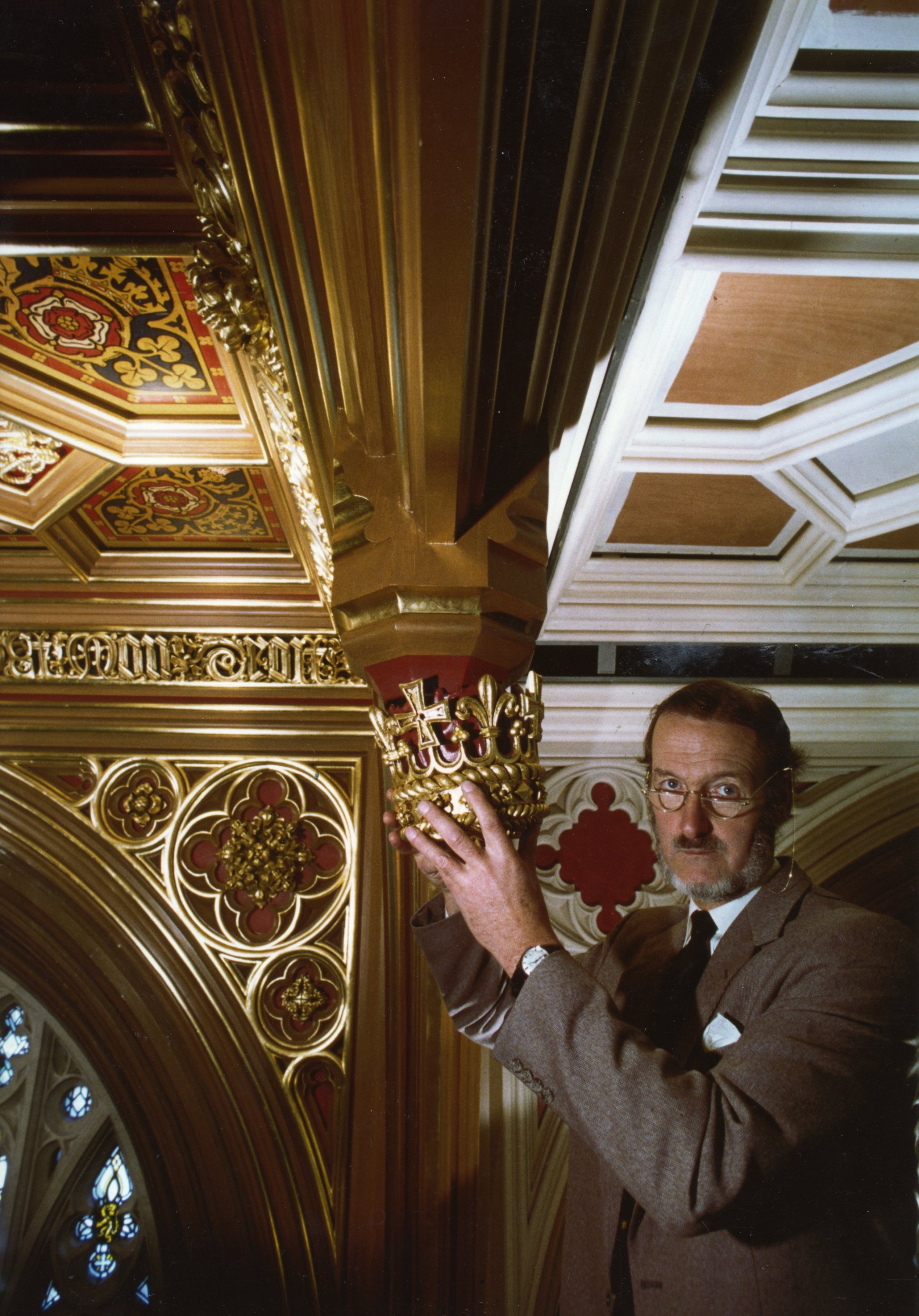
Above: Sir Donald Insall with a pendant that had fallen to the benches at the House of Lords.
In July 1980, a roof boss from the Gothic Revival ceiling of the House of Lords, designed by Augustus Welby Pugin, fell late at night on the seat regularly occupied by Lord Shinwell, former Minister of Fuel and Power in Clement Attlee’s post-war Labour government. In 1946, at the behest of Shinwell the garden and setting of Wentworth Woodhouse, the magnificent Baroque and Palladian Yorkshire country house, was bulldozed for a low quality and environmentally destructive open cast mine. An act of graceless class war on Shinwell’s part, the Labour peer was spared death by historic architecture. Today, Wentworth Woodhouse is being restored by Donald Insall Associates.
A man of great tact, charm and humour, Donald Insall, well known for turning up at his Mayfair office from his 18th Century house on Kew Green on a BMW 750 motorbike, retired as Chairman of his practice in 1998. He continued as a regular consultant until his death.
“I think that as a result of our experience over the years”, he said, “we have developed a method that we feel is a wise one. We always try to make friends with the building itself, but also with its current users, so that both their respective needs can be met. We prepare a life story of the building, and from there we assess the building’s positive aspects. We also take a look at its less successful features and see how these can be helped. However, the important thing is to take a positive approach to the project.”
Donald Insall was knighted in 2010. CBE in 1995. OBE in 1981.
Survived by his wife, Libby Insall, and his three children, Robert, Christopher and Hilary.


